
Consider these points when driving with a rear bike carrier in Germany, Austria or Switzerland
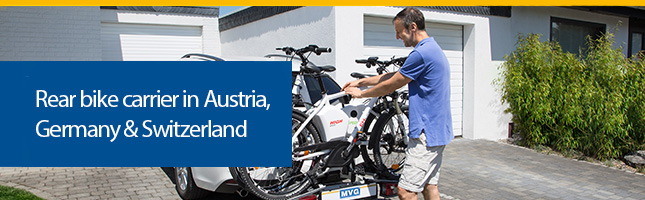 For transporting bicycles, the rear bicycle carrier is above all practical and uncomplicated. But so that your journey goes without problems, you should definitely keep a few points in mind when driving in Germany, Austria or Switzerland.
The third license plate is compulsory in Germany
Once your rear bike carrier is loaded, it mainly covers the license plate. According to the German StVO, the license plate must always be visible. In Germany it is therefore mandatory to attach a third license plate, i.e. a replacement license plate, to the rear bike rack. When buying the carrier, it is best to ensure that it has a way of attaching the license plate. You can easily get a third license plate from the Road Traffic Office. The best thing to do is to mount it firmly on the carrier so that it cannot be forgotten. Important: It is not necessary to stamp the license plate.
Also make sure that the lighting of your vehicle is not covered when transporting the bicycles. Since this often cannot be avoided, your rear bike carrier should also have lighting that can be connected to the vehicle electronics via the socket at the rear.
In Austria you need a red license plate
In Austria, too, you have to mount a third license plate on the rear bike rack if your cargo covers the original license plate. The specialty, however, is that you need a red license plate. You also have to pay attention to the lighting on the rear bike carrier, which is already known from Germany.
The load securing and loading of the rear bike carrier in Switzerland
In addition to the third number plate and the lighting, there is a special focus on loading the rear bike carrier and securing the load in Switzerland. The bicycles must explicitly not be wider than the vehicle and not pose a risk to road traffic. There is an interesting special rule with regard to the dimensions: the bike must not exceed the total length of two meters, but it would also be okay if the bike protrudes 20 cm on each side above the vehicle. If you have an accident in Switzerland due to an incorrectly secured load, you will have to pay for the damage in any case. In our neighboring country, make sure to lash the bikes tightly and use all the safety measures provided on the rear bike carrier. Uninstall any other parts on the bike that could easily fall off, such as air pumps, saddle pads or baskets, and avoids the use of a cover. Above all, the latter would also affect the driving behavior of your vehicle.
The speed limit with the rear bike rack
Most European countries do not have a speed limit for driving with a rear bike rack, but you should pay attention to what the manufacturers of the rack specify and you should not exceed these values.
Make sure to also pay attention to the rules for transport on the rear bike carrier in other EU countries.


